Sam’s Club Credit Card and Mastercard Rewards, Rates and Rules


The Sam’s Club credit card that earns rewards is the Sam’s Club Mastercard, which has no annual fee and pays 5% back in Sam’s Cash on gas, 3% on dining and 1% on other purchases.
At Sam’s Club itself, it pays 3% to Plus members and 1% to Club members. Plus members also keep the membership’s own 2%, for up to 5% back on club purchases.
Synchrony Bank issues the card. Applicants who don’t qualify for it are considered for a store card instead, and that one earns no Sam’s Cash at all.
The four Sam’s Club cards
Synchrony issues four Sam’s Club cards, two for consumers and two for businesses, and only the two Mastercards earn Sam’s Cash.
| Card | Sam’s Cash | Account starts with |
|---|---|---|
| Sam’s Club Mastercard | 1% to 5% | 5213 |
| Store card | None | 7714 |
| Business Mastercard | 1% to 5% | 5560 |
| Business store card | None | 7715 |
Confusingly, the store card’s official name is the Sam’s Club Credit Card, the same words most people use for the Mastercard. Both consumer cards double as the membership card, and the store card is for Sam’s Club and Walmart purchases.
Sam’s Club’s credit page says applicants are considered for the Mastercard first and, if they aren’t approved, for the store card. It also says the prequalification check has no impact on your credit score.
You can apply online or at a club’s Membership Desk with a current Sam’s Club membership and a physical U.S. mailing address. Authorized users on the account have to be on the membership too.
The first four digits of the account number show which card you have. The prefixes above come from Sam’s Club’s credit contact page, which gives each card its own phone line.
What the Sam’s Club Mastercard earns
The Sam’s Club Mastercard pays all of its rewards in Sam’s Cash, at four rates.
- 5% at gas stations and EV chargers on the first $6,000 a calendar year, then 1%.
- 3% on dining and takeout.
- 3% on Sam’s Club purchases for Plus members, including Scan & Go and SamsClub.com, and 1% for Club members.
- 1% on other purchases.
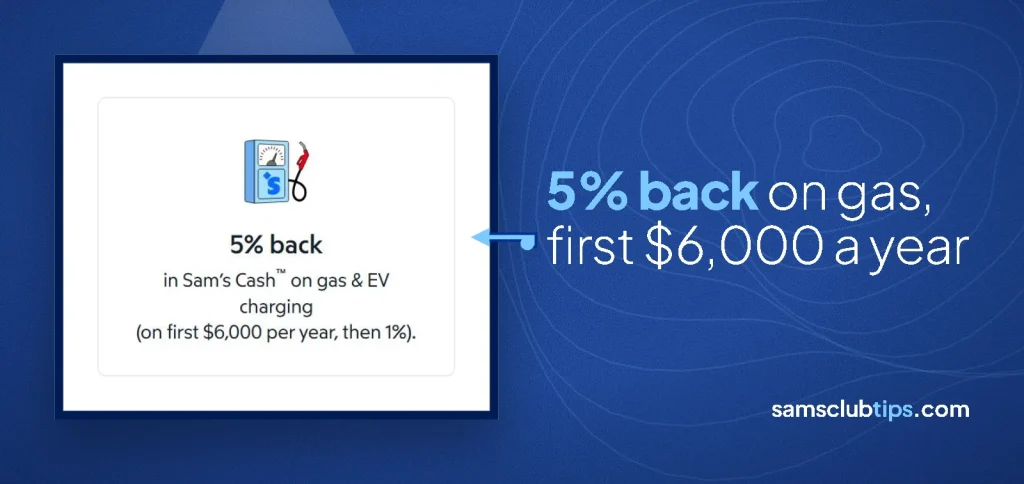
Two caps limit the earning. The 5% on gas covers only the first $6,000 of a calendar year, so the most that rate can pay is $300 a year.
The other cap is $5,000 in Sam’s Cash per calendar year, counting a member’s personal and business cards together. It’s separate from the $750 cap on the Plus 2%.
No household is likely to hit it. At 3%, reaching it takes about $166,667 of spending a year, by my count, and the sample household below earns $378 a year on the card, under 8% of the limit.
Cash advances, tobacco and e-cigarettes, prescriptions, gift cards, prepaid cards, traveler’s checks and other cash equivalents earn nothing. Returns take back the Sam’s Cash a purchase earned.
Gas also depends on how the station codes the sale. The card’s rewards terms warn that fuel from a grocery store’s pumps may not count as a gas station purchase, and then it earns 1%.
The card works anywhere Mastercard is accepted and charges no foreign transaction fee.
New accounts get a $60 credit through December 2
New Sam’s Club credit accounts approved between October 28 and December 2, 2026 get a $60 statement credit, double the usual $30, after $30 of Sam’s Club purchases in the first 30 days. The business cards get the same $60.
Cash advances, gift cards, alcohol, tobacco and pharmacy purchases don’t count toward the $30. The $60 lands on the account within 90 days of those purchases, not as Sam’s Cash.
The math for Plus and Club members
The Sam’s Club Mastercard changes the case for Plus. With the card, the upgrade from Club needs half as much club spending to pay for itself.
The Plus upgrade breaks even at $1,500
Plus has cost $120 a year and Club $60 since May 1, 2026. On qualifying purchases in a club, a Plus member with the card earns 5%, the card’s 3% plus the membership’s 2%, while a Club member with the card earns 1%.
By my math, that 4-point gap covers the $60 difference at $1,500 of in-club spending a year, about $125 a month. Without the card, the 2% alone needs $3,000.
The membership’s 2% counts purchases in clubs and through Curbside Pickup, up to $750 a year, but not shipped or delivered SamsClub.com orders. On those, the gap is just the card’s 2 points, so the breakeven goes back to $3,000.
The 3% also follows the name on the Plus membership. The card’s rewards terms say an add-on member with a Mastercard of their own earns the Club rate unless the Plus membership is in their name.
None of this counts Walmart+, which Plus has included since October 20, 2026 for the primary member who links accounts, and which costs $98 a year on its own. The other Plus membership perks sit outside the math too.
A sample household
To see the whole card at work, take a household that puts $15,000 a year on it, with $4,800 spent in the club, $2,400 on gas, $1,800 on dining and $6,000 on everything else. Worked out from the listed rates, the Plus version earns $474 in Sam’s Cash a year and the Club version $282.
| Spending | Plus with the card | Club with the card |
|---|---|---|
| Sam’s Club, $4,800 | $240 | $48 |
| Gas, $2,400 | $120 | $120 |
| Dining, $1,800 | $54 | $54 |
| Other, $6,000 | $60 | $60 |
| Total | $474 | $282 |
The Plus figure for club spending includes the membership’s 2% and assumes every purchase qualifies. After the fee, Plus keeps $354 and Club $222, so Plus finishes $132 ahead at this level of spending.
For a Club member, I’d call this a gas card first. Gas earns $120 of that household’s $282, while $4,800 of club spending earns $48.
Against the Costco Anywhere Visa
The Costco Anywhere Visa by Citi is the closest rival. Citi’s card page lists 5% on gas at Costco and 4% on other gas and EV charging, on a combined $7,000 a year before it drops to 1%.
It also pays 3% at restaurants and on eligible travel, 2% at Costco and Costco.com and 1% on other purchases. Like the Sam’s Club Mastercard, it has no annual fee or foreign transaction fee, and it requires a Costco membership in your name.
Two differences matter more than the rates. Costco warehouses take Visa as their only credit card, so the Sam’s Club Mastercard can’t be used inside one, and the Costco card pays once a year, as a reward certificate after the February statement.
For the same household, buying its gas at Costco, the Costco Visa earns $330 a year. A Gold Star membership at $65 leaves $265, and an Executive membership at $130 adds 2% on Costco purchases, up to $1,250 a year, for $426 earned and $296 after the fee.
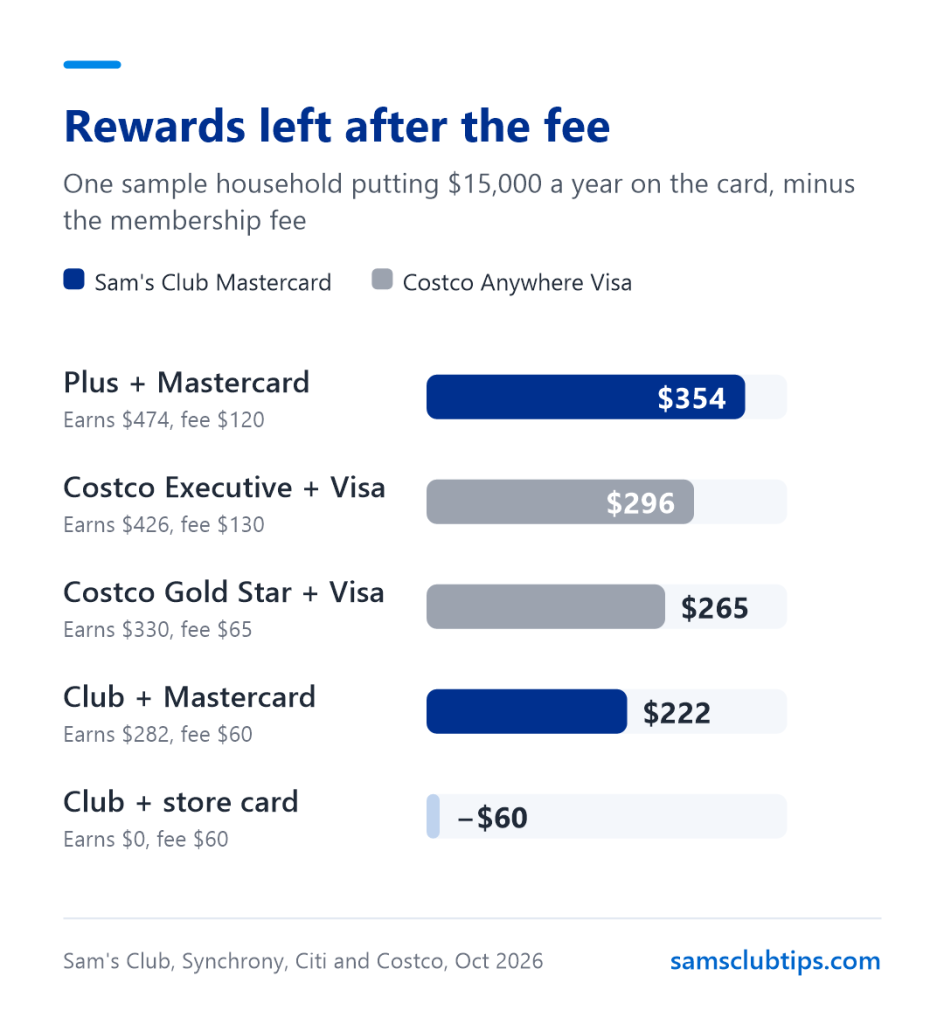
On these numbers, Plus with the Mastercard finishes first and Club with the store card last, $60 behind with nothing earned. None of it counts what each club charges at the register, which Sam’s Club vs Costco compares.
When Sam’s Cash posts and when it’s lost
Sam’s Cash from the card is issued within one to two billing cycles of the purchase, according to the card’s fine print. Sam’s Club’s credit FAQ says it’s issued monthly and loaded onto the membership automatically.
Some card reviews still describe a yearly payout. That changed in April 2022, when Sam’s Cash replaced the card’s old cash back rewards and started paying monthly.
Sam’s Cash can pay for most purchases in a club or on SamsClub.com, or be taken as cash at a club.
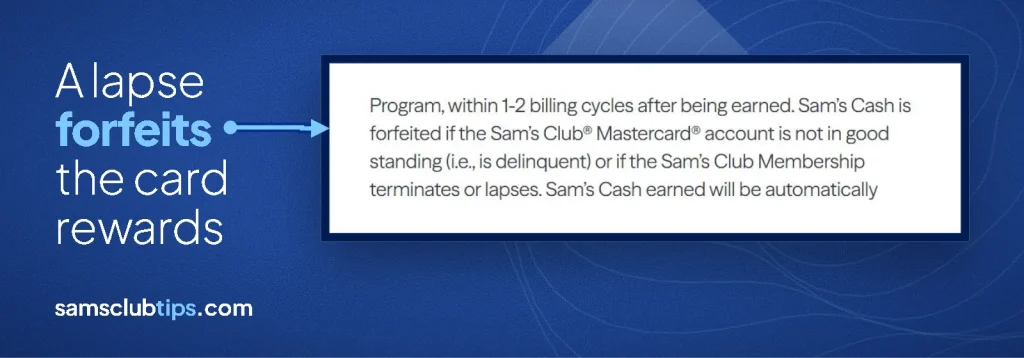
The same fine print names two ways to lose it. Sam’s Cash is forfeited if the card account is delinquent, or “if the Sam’s Club Membership terminates or lapses.”
That’s stricter than the membership’s own rule for Plus rewards, which are forfeited only after more than six months lapsed. The card’s rewards terms, a 2022 PDF, are gentler too, saying a member can redeem after reactivating, but the current pages on SamsClub.com and Synchrony’s site don’t repeat that.
If a Sam’s Club membership might lapse, spend the card’s Sam’s Cash first. The current card terms say a lapse forfeits it and mention no grace period.
Closing the card is a different case. Per the rewards terms, Sam’s Cash already issued stays on the membership, but anything earned and not yet issued is lost.
Carrying a balance at 20.40% or 28.40%
New Sam’s Club Mastercard accounts carry a variable purchase APR of 20.40% or 28.40%, and the store card 28.90%, in the new-account rates on Synchrony’s Sam’s Club page, dated October 1, 2026.
Cash advances cost 25.40% or 31.40%, plus a 3% fee with a $5 minimum, and the minimum interest charge is $2. SamsClub.com’s credit page still showed the older January 1, 2026 rates on October 22, with the Mastercard at 20.15% or 28.15%.
By my math, a $1,000 balance carried for a full year costs about $204 in interest at 20.40% and about $284 at 28.40%, before compounding.
At 28.40%, a $1,000 balance costs more in a year than the sample Club household earns on the card.
Rewards of 1% to 5% can’t keep pace with interest above 20%, so the card’s value rests on not carrying a balance. On the store card, which earns nothing, every dollar of interest is pure cost.
Autobill and other account rules
Sam’s Club’s credit FAQ and help pages add a few rules for cardholders.
- Autobill is added to every Sam’s Club credit account and charges the $60 or $120 membership fee to the card when the membership renews, with the receipt on the next statement. Mastercard holders on Autobill get no renewal notice.
- Autobill is separate from the Auto Renew setting, and the FAQ says to call Sam’s Club Credit to turn it off.
- The bill can’t be paid at a club, since the Membership Desk no longer takes credit card payments. Payments go online through Synchrony, by phone or by mail.
- A payment by check can take 7 to 14 days to free up available credit.
- A new card arrives in 7 to 10 business days. An account opened online or in the app can’t be used at in-club registers until it does, though the FAQ says temporary cards stay valid for up to 25 days after approval.
- Clubs can help with applications and lost or stolen cards. The Mastercard line, 866-220-0254, answers 24 hours a day, and the store card line is 800-964-1917.
Who should skip the card
The card has no annual fee, so the test is whether it earns enough to matter. For some members it doesn’t.
Anyone who carries a balance is first on that list. At 20.40% or 28.40%, the interest on even a modest balance outruns 1% to 5% back.
Applicants who land the store card get a 28.90% APR and no Sam’s Cash, with little in return beyond a card that doubles as the membership card.
Costco households gain little, since Costco’s warehouses take only Visa credit cards and the Costco Visa earns 2% there.
Members who might let the membership lapse put the card’s Sam’s Cash at risk along with it.
Light drivers lose the biggest earner. Gas brings in $120 of the sample Club household’s $282 and tops out at $300 a year, while Sam’s Club’s member gas prices come with the membership, card or not.
Prices, fees and policies were checked when this guide was last updated and can change without notice. Sam’s Club Tips is an independent site and is not affiliated with Sam’s Club or Walmart Inc.